Car Air Conditioning Condensers: Signs of Failure, Repair Options and Replacement Cost
Short answer
A car air conditioning condenser is the front-mounted heat exchanger that turns hot refrigerant gas back into liquid. It is the most common leak point on a car air con system, it cannot be reliably repaired, and in the UK replacement typically costs around £280 in total — about £60–£150 for the part plus £229 for fitting, seals, vacuum, leak test and a full re-gas.
Key takeaways
- The condenser sits in front of the radiator and takes the full force of stones, insects and road salt, which is why it leaks first.
- Air con that goes warm within weeks of a re-gas is a leak, not lost gas.
- Condensers are sealed aluminium pressure vessels — welding or sealant is not a lasting repair.
- Fixed £229 fitting and full re-gas when you supply the part; typical all-in cost around £280 versus £450–£750 at a garage.
If your car's air conditioning has slowly stopped blowing cold, the condenser is the first thing an air conditioning specialist will look at. It sits right at the front of the car, in the firing line of every stone, insect and shovel of winter road salt, and it is by far the most common leak point on a modern air con system.
This guide explains what the condenser does, how to spot a failing one, whether it can be repaired instead of replaced, and what a fair UK price looks like for condenser replacement and re-gas.
What does a car air conditioning condenser do?
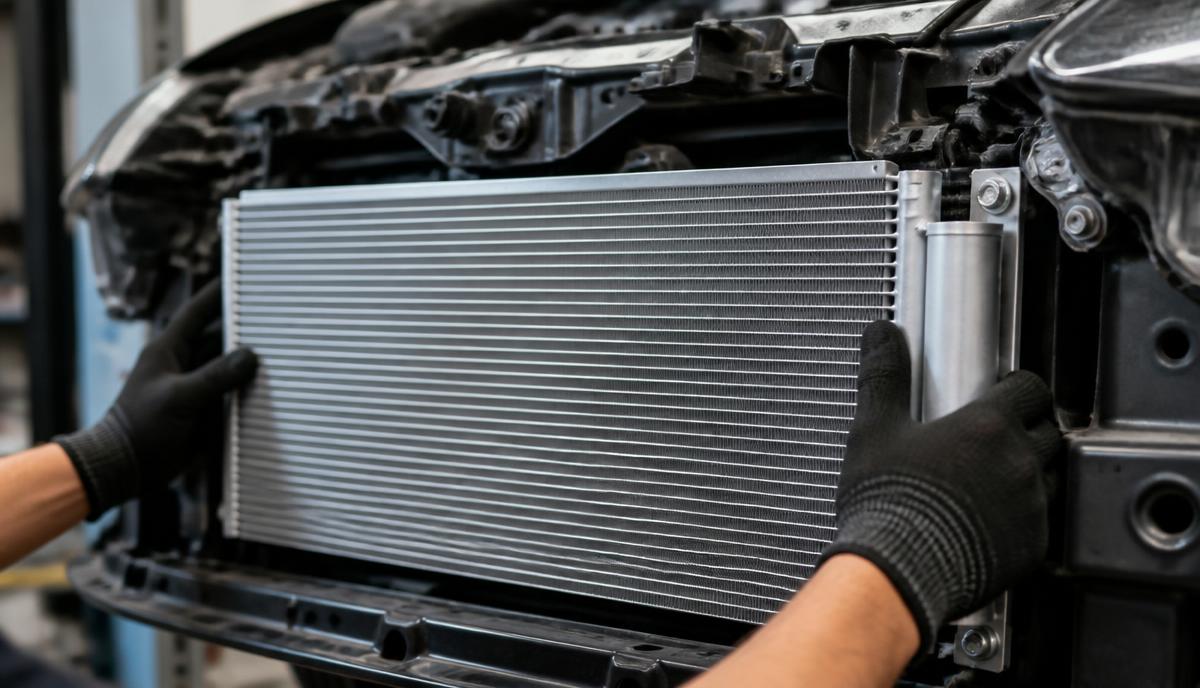
The condenser is the flat, radiator-looking unit mounted in front of your engine radiator — which is why people also call it the air con rad or AC radiator. The compressor pumps hot, high-pressure refrigerant gas into it, and airflow through the grille cools that gas back into a liquid. That liquid then passes through the expansion valve and evaporator inside the dashboard, where it absorbs heat and gives you cold air at the vents.
No working condenser means no pressure drop, no phase change, and no cold air. It is a sealed pressure vessel, so even a pinhole is enough to let the refrigerant escape over a few weeks.
Signs your air con condenser is leaking or failing
- Air con that blows cool for a few weeks after a re-gas, then goes warm again — a classic slow leak.
- Air that is lukewarm at idle or in traffic but improves at motorway speed.
- Oily, greasy residue or bright dye staining on the front of the condenser or the surrounding pipework.
- Visible stone damage, bent fins, or white/green corrosion on the aluminium face.
- A musty or chemical smell from the vents, or the compressor clutch cycling on and off rapidly.
- The system takes no gas at all when tested — it has already emptied itself.
A single re-gas that lasts a full season is normal maintenance. A re-gas that lasts weeks is a leak, and leaks do not repair themselves.
Why condensers fail in the UK
Almost every condenser we replace fails for the same reasons. The unit is thin aluminium, mounted ahead of everything else, and it takes constant impact from grit thrown up off the road. Winter road salt then attacks the exposed metal, corroding the tubes and joints until a pinhole opens. Cars that do a lot of motorway miles, and any vehicle over about six or seven years old, are the most common candidates.
Can a condenser be repaired instead of replaced?
In almost all cases, no. Modern condensers are thin-wall aluminium with parallel-flow micro-channels. Welding or brazing a corroded section rarely holds pressure, and even a successful patch usually leaks somewhere else within months because the whole face has corroded at the same rate. Replacement with a new unit, followed by a vacuum test and fresh refrigerant, is the only reliable fix.
How much does air con condenser replacement cost in the UK?
Main dealers and general garages typically charge somewhere between £450 and £750 for a condenser replacement and re-gas, because the part is marked up heavily on top of the labour. Buying the condenser yourself from a trade air con parts supplier and paying a fixed fitting price is significantly cheaper.
- £229 fixed price to fit your supplied condenser, including vacuum, leak test and re-gas.
- Roughly £50 for the part on most common cars, ordered direct from the supplier and delivered next working day.
- £35 for a diagnostic if the leak has not already been confirmed.
That puts a typical all-in total around £280 rather than £500 plus — for the same new part and the same refrigerant.
What a proper condenser replacement should include
- Leak confirmation before any parts are ordered, so you are not replacing the wrong component.
- Correct part matched to your registration and refrigerant type (R134a or R1234yf).
- Receiver drier or filter renewed where the design requires it.
- Full vacuum down and hold test to prove the system is sealed before gassing.
- Correct weighed refrigerant charge and oil quantity for the vehicle.
- Vent temperature and pressure check on completion.
How to make a new condenser last
- Rinse road salt off the front of the car through winter, including through the grille.
- Run the air con for ten minutes at least once a fortnight, all year round, to keep the seals lubricated.
- Keep the grille and condenser face clear of leaves, insects and debris.
- Get a slow leak diagnosed early rather than topping up gas repeatedly.
Get your condenser replaced
We are a home-run business specialising in car air conditioning, and we have been carrying out condenser replacements for six years for www.staykool.co.uk customers — thousands of them, across all makes and models. Fitting is carried out at our unit in Alvaston, Derby.
See the full condenser fitting service and pricing, or book a slot online with Darren.
Frequently asked questions
Can a car air conditioning condenser be repaired instead of replaced?
In practice, no. The condenser is a thin-walled aluminium pressure vessel operating at high pressure, so welded repairs and stop-leak additives fail quickly and can contaminate the rest of the system. Replacement is the only reliable fix.
How much does a car air conditioning condenser replacement cost in the UK?
Expect around £280 in total: the condenser itself is usually £60–£150 depending on the make, and fitting with new O-rings, a vacuum, a leak test and a full re-gas is a fixed £229. Garages and dealers typically charge £450–£750 for the same work.
How long does it take to replace an air con condenser?
Around two hours on most cars. You drop the car off at your booked time and collect it the same day with the system fitted, vacuum-tested and re-gassed.
Is it safe to drive with a leaking air con condenser?
The car is still driveable — the air con simply blows warm. The risk is running the compressor on a system that has lost its refrigerant oil, so switch the air con off until the condenser is replaced.